
















While AI dominates the headlines, another paradigm shift is quietly brewing. Quantum computing promises to redefine how we tackle the hardest problems in finance —not by making today’s computers faster, but by computing in a completely different way.

Quantum Computing in Finance: From Hype to Potential
“We still don’t know why quantum computers work so well — but we know they work.” That quote from Tenity’s recent Corporate Roundtable: Unlocking the Potential of Quantum Computing neatly captures where the field stands today: fascinating,complex, and often misunderstood.
While AI dominates the headlines, another paradigm shift is quietly brewing. Quantum computing promises to redefine how we tackle the hardest problems in finance —not by making today’s computers faster, but by computing in a completely different way.
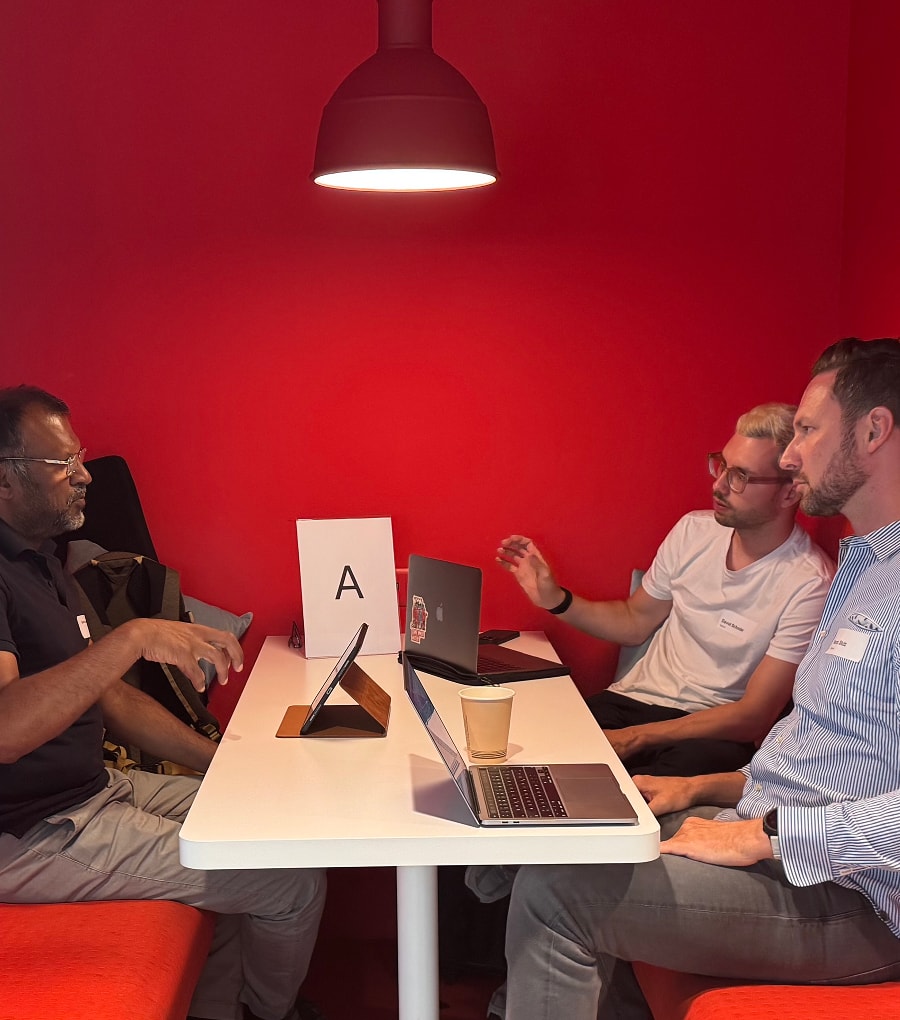
At Tenity, our mission is to bring clarity to emerging trends. That’s why we gathered Mathias Soeken,Principal Quantum Software Architect at Microsoft, Fraser Levick, Investment Analyst QAI Ventures, and pioneering quantum startup founders, Pavel Hrmo, CEO of ZuriQ, Stiepan Kovac, CEO of Quantum Resistant, Iordanis Kerenidis, Co-Founder and CTO of Quantum Signals, to explore what quantum really means for financial innovation, where the opportunities lie, and how the industry should prepare.
Why Quantum Computing Matters for Finance
From the abacus to mainframes to AI, computing has driven every leap in finance. Butclassical systems hit a wall when problems become too complex. Quantum computing breaks those limits — not universally, but for a specific class of problems.
For finance, three areas stand out:
· Portfolio optimization:balancing returns, risks, and constraints at scales classical solvers struggle with.
· Risk and pricing models:accelerating complex Monte Carlo simulations used for derivatives and value-at-risk.
· Cryptography: quantum machines could one day break widely used encryption, making post-quantum cryptography(PQC) a top priority.
As one expert reminded us: “Quantum isn’t about big data, it’s about big compute. Problems that take forever today those are the ones to focus on.”
Separating Hype from Reality
A common misconception is that quantum computers are just “faster laptops.” They’re not.They’re slower at many tasks, but exponentially better at a few. Where we are today:
- Hardware: competing approaches(superconducting qubits, trapped ions, neutral atoms, photonics) are advancing,but no clear winner has emerged.
- Algorithms: smarter algorithms are cutting resource requirements, moving us closer to practical advantage.
Investors have noticed. The field has attracted over $10 billion globally, withhigh-profile exits like IonQ’s acquisition of Oxford Ionics. Reports from McKinsey on quantum technology forecast a market worth over $200 billion by 2040.
“Quantum is one of the only truly new compute paradigms beyond AI.”
Security First: Preparing for the Quantum Threat
The most urgent action item for banks? Upgrade encryption.
Attackers are already harvesting data today, waiting until tomorrow’s quantum machinescan decrypt it (“harvest now, decrypt later”). Transitioning to quantum-safe standards is the single most important step financial institutions can take. Stiepan Kovac, CEO of Quantum Resistant, has highlight:
- A quantum-resistant SIM/eSIM patent, now approved in the US, EU, and Japan.
- Integration of enhanced AES andHQC (a NIST candidate) in memory-safe Rust.
- Validation for side-channel resistance, making it resilient against practical attacks like RF leakage.
- Recognition by a UN-affiliated standards body as a good practice for quantum-safe 5G.
- DARPA “awardable” status for defense-grade applications.
This is not just for telecoms it applies directly to financial services, where authentication and secure transactions are mission-critical. “Investing in quantum technology today is about preparing for the breakthroughs of tomorrow.”
Quantum Computing Use Cases in Finance
Short-term (0–2 years):
- Begin PQC migration.
- Explore quantum through sandbox pilots with startups and cloud platforms.
Medium-term (5–10 years):
- Risk modeling: quantum-enhancedMonte Carlo for faster, cheaper simulations.
- Fraud detection: quantum ML analyzing multiple correlated features to detect anomalies.
Long-term (10+ years):
- Portfolio optimization andexotic pricing at scales classical machines cannot handle.
The Future Stack: AI + HPC + Quantum
The most exciting applications may not be quantum alone, but in combination with AI and HPC:
- AI narrows the field by learning from past data.
- HPC performs scalable simulations.
- Quantum is applied only to the hardest, most complex cases.
- Results loop back into AI models for continuous improvement.
“The intersection of AI and quantum computing holds the promise of unprecedented advancements.” For finance, this could mean AI-driven trading models enriched by quantum-simulated risk dynamics.
The Hardware Race
Quantum hardware remains diverse: superconducting qubits, trapped ions, neutral atoms, photonics.
Two key truths:
- Quality matters more than quantity: a handful of stable qubits beats hundreds of noisy ones.
- Algorithms and error correction are advancing fast, reducing hardware needs.
Pavel Hrmo, CEO of ZuriQ, presented a 2D trapped-ion approach to improve connectivity and scalability — a reminder that the final winners may not be today’s frontrunners.
Quantum Investing: A Trillion-Dollar Opportunity
By 2040, the global quantum market could exceed $200 billion, with finance one of the top beneficiaries.
In Europe, quantum computing is already among the top deep-tech investment areas,and the momentum is accelerating.
“The acceleration within the next five to ten years is really expected to pick up.”
What Financial Institutions Should Do Today
So, what’s actionable now?
Prioritize quantum-safe encryption
- Inventory cryptographic assets.
- Begin pilot migrations to PQC.
- Build crypto-agility forlong-term compliance.
Experiment and learn
- Use cloud-based platforms like Microsoft Azure Quantum to test early use cases.
- Partner with startups to gaininsights.
Monitor convergence
- Track how AI + HPC + quantum workflows evolve.
- Focus on big compute problems where quantum will truly matter.
Tenity’s Role: Navigating the Frontier
Tenity exists to help corporates and startups make sense of what’s next.
Our roundtables cut through the noise, convening industry leaders, researchers, and investors to focus on what’s actionable today. From AI in Banking to Quantum in Finance, we’ll continue to host the conversations that shape the future of financial innovation.
Looking Ahead
Quantum computing may be on the horizon, but financial institutions cannot afford to wait. The winners of tomorrow will be those preparing today — securing their data, experimenting with pilots, and building the right partnerships. At Tenity, we’ll keep creating the spaces where these frontier discussions happen.Because the future of finance isn’t just about faster transactions or smarter algorithms.
It’s about rethinking what’s possible.